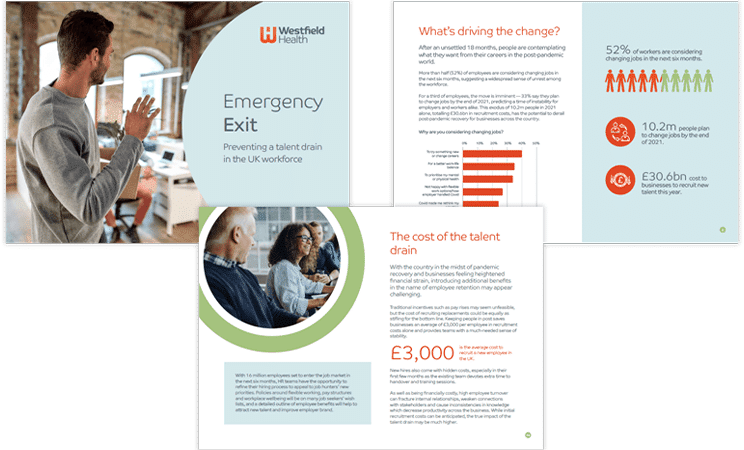
As the UK has adapted a lot over recent years, so has the workplace, and one of these emerging changes has been the struggle for businesses to improve their employee retention risk. Our latest 2026 report revealed that 22.3% are considering changing jobs in the next years, and a following 12.7% are actively looking. These figures represent a significant portion of UK employees that are reporting dissatisfaction with their current employer or position.
As the UK employee turnover rates across the whole of the UK reached 35% in May 2026, it is non-negotiable that workplaces must now consider how they improve their employee retention strategies and build a workplace culture and beenefits package that attracts and keeps the top talent.
How Workplace Wellbeing Supports Employee Retention: Key findings
The Westfield Health Wellbeing Survey takes a review of 2000 workers from across the UK. When asked about their attitudes and beliefs around employee retention, we found that:
- 12.7% of UK workers are actively seeking new employment opportunities in the next year
- 22.3% of UK workers are considering changing jobs in the next year
- 25.3% of workers consider workplace culture within their top three consideration for new employment, outside of salary
- 50.8% of workers consider benefits offered within their top three motivator when looking for a new employer
- 34% of workers feel HR are responsible for employee wellbeing in their workplace
New priorities drive mass job change
With 36% of employees actively applying or considering changing jobs in the next six months, the workforce looks set to enter another period of unrest.
Their reasons suggest that employees have seen a shift in their priorities, with many seeking improvements to their working style or mental or physical health. Employees’ top three motivations for considering a new role are:
- Seeking a progression opportunities (26.9%)
- For a flexible working hours (60.2%)
- To find better alignment to company values (28.9%)
round a third of workers (30%) are considering a career break. Here, again, the top reason by far was to protect their mental health (29%). The usual reasons for taking time out were less of a priority, with only 13% saying they’d like to travel and 7% taking a break to raise children.
Find out more about employee retention strategies
To read more about the findings and how employers can prevent a talent drain, download our free Emergency Exit report.