
International Stress Awareness Week is the first week of November. Our brains are wired to expect familiarity, so when the future feels out of our control, it’s natural to feel stressed and uneasy. With 63% of people in the UK feeling stressed every week, Stress Awareness Week 2024 will focus on emotional management, reducing stigma and improving wellbeing.
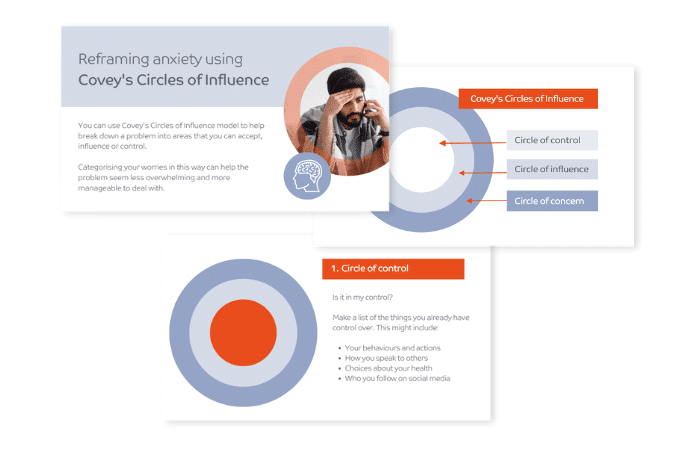
Stephen Covey’s ‘Circles of Influence’ model can help us refocus our thoughts on the things we can control, making future problems seem less overwhelming and easier to manage. You can use this model to help you break down a problem into areas that you can accept, influence or control. It can be used for both individuals and teams and could be used in 1:1s to help coach colleagues who are feeling overwhelmed.
How it works: Stephen Covey’s Circles of Influence & Control
Covey recommends that you attempt to let go of concerns that are out of your control, and instead focus on factors within your influence or control.
Sort your worries into three categories depending on how much control you have over their outcomes. This helps you put more energy into improving the things you can control and minimise anxiety about the things you can’t change.
Categorising your worries in this way can help the problem seem less overwhelming because you can build your plan of action around the things you can directly impact.
1) The Circle of Control
Ask yourself: what factors can I control?
Make a list of the things you already have control over. Remember you have control over the way you act and behave, so there might be more than you think. This might include:
- Your behaviours and actions
- How you speak to others
- Choices about your health
- Who you follow on social media
2) The Circle of Influence
Ask yourself: If I can’t control it, can I influence it?
While it might feel like there’s not a lot you can directly control, there’s likely to be more that you can influence. These are things where you can’t guarantee an outcome, but you have at least some sense of control. For example:
- Your relationships with other people
- How you plan your day
- Who you spend time with
- How often you say ‘no’
3) The Circle of Concern
Ask yourself: If I can’t influence or control it, can I try to accept it?
The Circle of Concern contains everything that you’re worried about in relation to the issue at hand. When you’re able to focus your energy on the things you can control, this circle should feel less overwhelming.
If it feels like there’s a lot in this category, you could try sharing your thoughts with a third party, such as a friend or colleague, to get a fresh perspective on which items might fit into the circle of influence instead.
Your circle might include things like:
- Politics
- The economy
- The weather
- Other people’s actions
Identifying your Circle of Influence
Identifying factors and challenges that fall within your team’s circle of influence is a positive exercise in creative, healthy perspective and reducing workplace stress and anxieties.
To begin identifying your circle of influence, you need to begin by reflecting on the things and actions in your life that you can directly change daily. These are the items that you and your team can control in your innermost circle of control. For example, this could include your personal behaviour, mindset and your daily habits or routine. In these instances, you have complete control over the factors impacting sources of stress.
Following this, you can identify your circle of influence by reflecting on the relationships and events that you have some control over. However, these items are not entirely under your control, and often the result is influenced by the actions and behaviours of multiple people.
Examples of things within your or your team’s circle of influence could include your relationships with co-workers or project outcomes at work. In these cases, you are not able to determine results, but you can offer some influence depending on your attitude, behaviours or actions.
Download the cue cards.
This PDF of quick-reference cards helps you use Covey’s Circles of Influence to manage stress for yourself and your team.
Download the cue cards as a PDF.
You can also visit our Understanding the Mental Health Puzzle page to read the latest research about mental health and stress in the workplace, including advice for managers and leadership teams.
How can Westfield Health help to reduce workplace stress
Westfield Health offers a number of wellbeing solutions that help support employee wellbeing and reduce stress. Our solutions are flexible to support businesses of all shapes and sizes, whether you have a central team or a distributed workforce. Our solutions start from as little as £1 per month per employee and include:
- Corporate fitness services
- Strategic consultancy
- Employee assistance programmes
- Health & lifestyle screenings
- Mental health first aid courses
- Webinars, workshops & training
- Health leadership training
- Wellbeing calendar
Find out more about how we can support your team in reducing stress and anxiety in the workplace through our Health Cash Plans for business and Private Health Insurance.
Circle of Influence & Control – FAQ
What is the Circle of Influence and Control?
The circle of influence and control is a thought model designed by Stephen Covey, which was detailed and published in Covey’s book ‘The 7 Habits of Highly Effective People’. The circle of influence and control can help individuals and teams to identify the areas that they can control, build resilience and reduce stress.
How can I use the Circle of Influence to reduce workplace stress?
Stephen Covey’s Circle of Influence and Control can be brought into the workplace to help your team reduce stress and anxiety by sorting the sources of their stress into what they can either control or influence. This can help you and your people to identify those factors that are outside of your control and influence, which can help to establish boundaries that promote work-life balance and wellbeing.
What are the benefits of using the Circle of Influence?
The core purpose behind Stephen Covey’s Circle of Influence & Control is to reduce stress and boost personal effectiveness. In the workplace, specific benefits for you and your team could include:
- Reduced stress: This exercise can help you to mentally detach from those factors that are outside of your control.
- Building a productive mindset: By understanding those factors that are within your complete control, more focus can be shifted to making a productive difference.
- Stronger relationship building: By focusing on your own behaviours and actions towards others, you and your team can build stronger and more respectful working relationships
- Building a sense of accountability: By taking the time to reflect on those factors within your control, every member of the team can gain a clearer understanding of what they are accountable for.